
Last Updated: May 2026 | By 24Betting Editorial Team

Emotional Discipline in Online Betting is one of the most important skills for long-term betting success. Many bettors lose money because of emotional decisions, chasing losses, and poor bankroll management instead of following a disciplined betting strategy. We have all been there. It is the final over of an IPL 2026 match. You have a bet riding on the outcome. Your heart is thumping against your ribs, your palms are sweaty, and your mind is racing. If they hit a six, you win big. If they get out, you lose.
In that moment, you aren’t thinking about math, logic, or “value.” You are feeling. And in the world of online betting, feelings are often the fastest way to lose your shirt.
If you want to move from being a “lucky gambler” to a “disciplined player,” you need more than just good tips or high odds. You need a mental armor. This emotional discipline in online betting guide is designed to give you that armor.
At 24betting.club, we believe that the smartest bettor isn’t the one with the most money—it’s the one with the most control. Let’s dive into the 3,000-word masterclass on how to keep your cool when the stakes are high.
Part 1: Why Does Betting Make Us So Emotional?
Before we can control our emotions, we have to understand why they exist in the first place. Betting is a “high-arousal” activity. This means it triggers deep-seated biological responses in your brain.
The Dopamine Rollercoaster
When you win, your brain releases a chemical called dopamine. It feels amazing. It’s the same chemical released when you eat your favorite food or fall in love. The problem? Your brain wants more of it immediately. This leads to “Overconfidence Bias,” where you feel like you can’t lose.
The Pain of the “Near Miss”
Studies show that a “near miss” (like losing a bet on the very last ball) triggers almost the same brain activity as a win. It creates a feeling of “I was so close! The next one will definitely hit.” This is a trap. In a random game of chance, being “close” doesn’t make you more likely to win next time.
The Fear of Missing Out (FOMO)
In the age of social media, we see everyone posting their “Big Wins.” We feel like we are falling behind. This pressure makes us take risks we can’t afford, just to “catch up” with the crowd.
Part 2: The Red Flags – When Emotions Are Winning
How do you know if you’ve lost your emotional discipline? In this emotional discipline in online betting guide, we categorize the “Red Flags” into three main behaviors. If you recognize yourself in these, it’s time to step back.
1. Chasing Losses (The “Revenge” Bet)
This is the most dangerous emotion in betting. You lose $500, and you feel angry. To “get back” at the house, you immediately bet $1,000 on the next available game—even if you know nothing about the teams. You aren’t betting to win; you are betting to stop the pain of losing.
2. The “Hot Hand” Fallacy
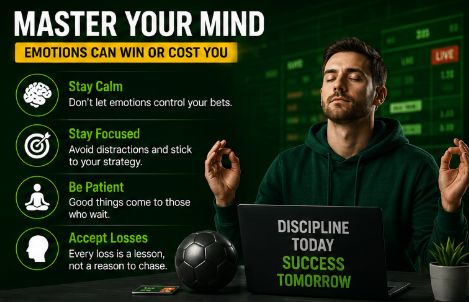
You’ve won three bets in a row. You feel like a genius. You decide to double your stakes because “I’m on a roll.” This is pure emotion. The deck doesn’t know you won the last three hands. The ball doesn’t know you won the last match. Each event is independent.
3. Increasing Stakes Out of Boredom
If you find yourself betting more money just because the game is “boring” and you want to make it “exciting,” you have lost your discipline. Betting should be a calculated decision, not a cure for boredom.
Part 3: The “Stop-Loss” for Your Mind
In trading, people use a “Stop-Loss”—a point where the computer automatically sells a stock to prevent further loss. You need a “Mental Stop-Loss.”
The 10-Minute Rule
Never place a bet immediately after a win or a loss. Your brain is flooded with chemicals for about 10 minutes after a result. Force yourself to walk away from the screen. Drink water. Talk to someone. Let the chemicals settle. Only then, ask yourself: “Does this next bet actually make sense?”
The “Why” Audit
Before you click “Place Bet,” ask yourself why you are doing it.
- Logical Why: “The data shows this team has a 60% chance of winning on this pitch.”
- Emotional Why: “I’m annoyed I lost the last one and I want my money back.”
If your “Why” is emotional, close the app.
“Successful betting is not about chasing wins every day. It’s about discipline, patience, and managing emotions over the long term.”
Part 4: Bankroll Management – Your Emotional Shield
You cannot have emotional discipline if you are worried about your rent money. This is a foundational rule of our emotional discipline in online betting guide.
The 1% Rule
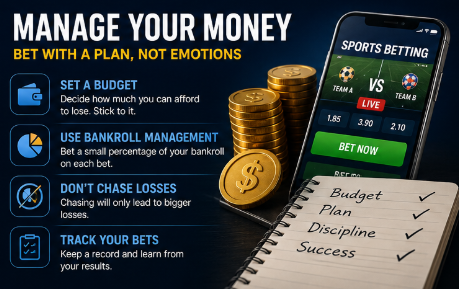
Never bet more than 1% of your total betting bankroll on a single event.
- If you have $10,000 in your wallet, your max bet is $100.
- Even if you lose, you still have 99% of your money left.
This mathematical safety net prevents the “Panic” emotion. If you bet 50% of your money and lose, you will panic. If you lose 1%, you can stay calm and move on to the next opportunity.
Separate Your Wallets
Never, ever use your daily living money for betting. Create a separate “Entertainment Fund.” When that fund is empty, the game is over for the month. No exceptions.
Betting Discipline Statistics
Many experienced sports bettors risk only 1% to 3% of their total bankroll per bet to reduce emotional decision-making and avoid major losses during losing streaks. Bankroll management is considered one of the most important long-term betting strategies among professional bettors and responsible gambling experts. Professional bettors often use strict bankroll management and rarely risk more than 1–3% of their bankroll on a single bet.
Part 5: Dealing with “The Tilt”
In poker, “Tilt” is when a player gets so angry at a “bad beat” that they start playing like a crazy person. It happens in sports betting and casinos too.
How to Reset After a Bad Beat
A “bad beat” is when you do everything right, but a freak accident (like an injury or a miracle catch) causes you to lose.
- Step 1: Accept the Randomness. Sport is chaos. Sometimes the better team loses. That is the nature of the game.
- Step 2: Check Your Process. If your logic was sound, don’t change your strategy. Stick to the plan.
- Step 3: Log the Loss. Write it down in a betting journal. Seeing it on paper takes the “mystery” and “fear” out of it.
Part 6: Betting on the Casino – Staying Safe in the Digital Room
Online casinos are designed to be immersive. The lights, the sounds, and the fast pace are all built to keep you in an emotional state.
The “Time-Out” Strategy
Set an alarm on your phone for every 30 minutes. When it goes off, you must stand up and leave the room for 2 minutes. This breaks the “trance” that casinos try to put you in.
Know the Math, Not the Hype
Every casino game has a House Edge. If you understand that you are playing against a mathematical disadvantage, you will stop taking losses personally. It’s not the universe hating you; it’s just the math of the game.
Part 7: The Social Pressure – Betting with Friends
Sometimes, our friends are the biggest threat to our emotional discipline.
- “Bro, just bet $500, it’s a lock!”
- “Don’t be a coward, go all-in.”
Discipline means having the strength to say “No” to the crowd. Real pros don’t bet on “locks”—because locks don’t exist. Real pros bet on value. If your friends are pressuring you to bet more than your 1% limit, they aren’t helping your game.
Part 8: The Long-Term Mindset (The Marathon)
Betting is not a way to “get rich quick.” If that is your goal, you will always be emotional because you are desperate.
Think of betting like a marathon.
- A marathon runner doesn’t panic if they have one slow kilometer.
- They don’t sprint at the start just to “show off.”
- They stick to their pace.
Your “pace” is your bankroll management and your research. If you have a bad week, it doesn’t matter. What matters is where you are after 1,000 bets, not 5 bets.
Part 9: Using Technology to Protect Yourself
At 24betting.club, we encourage using the tools built into modern betting platforms to help maintain your emotional discipline.
- Deposit Limits: Set a daily or weekly limit. Once you hit it, the app won’t let you add more money. This stops “impulse” deposits during an emotional moment.
- Reality Checks: Set a pop-up that tells you how long you have been playing.
- Self-Exclusion: If you feel like you are losing control, use the “Self-Exclusion” feature for 24 hours or 7 days. It’s not a sign of weakness; it’s a sign of a professional taking a tactical break.
Part 10: Conclusion – Your New Path to Success
Mastering your emotions is the hardest part of online betting. It is much harder than reading a pitch report or analyzing a player’s stats. But it is also the most rewarding. Emotional discipline is the foundation of long-term betting success. Smart bankroll management, patience, and controlled decision-making can help bettors avoid emotional mistakes and improve consistency over time. Emotional discipline is one of the most important skills in online betting. Bettors who control emotions, avoid chasing losses, and follow bankroll management strategies have a better chance of long-term success and responsible gambling.
When you master emotional discipline, you stop being a victim of the “highs and lows.” You become a steady, calculated player who enjoys the game without the stress.
Summary Checklist for Your Emotional Discipline:
- Limit your stakes to $1\%$ of your bankroll.
- Wait 10 minutes after every result before betting again.
- Never bet to “get back” lost money.
- Treat betting as entertainment, not a salary.
- Stay hydrated and take physical breaks from the screen.
Online betting should be fun. It should add excitement to your favorite sports, like the IPL 2026. By following this emotional discipline in online betting guide, you ensure that the game stays in your hands—and never in your head.
Stay smart, stay calm, and we will see you at 24betting.club for the next big match!
FAQ
What is emotional discipline in betting?
Emotional discipline in betting means controlling your emotions while placing bets and making gambling decisions. It helps bettors avoid impulsive actions like chasing losses, overbetting, or betting out of frustration. A disciplined bettor follows a strategy, manages their bankroll carefully, and avoids emotional reactions after wins or losses.
Why do bettors chase losses?
Many bettors chase losses because they want to recover lost money quickly. After losing several bets, emotions like frustration, anger, or desperation can lead to risky decisions and larger bets. Chasing losses often results in even bigger losses and poor bankroll management.
How can bankroll management help?
Bankroll management helps bettors control spending and reduce financial risk. By setting betting limits and using only a small percentage of their bankroll per bet, players can avoid emotional betting decisions and protect themselves from major losses. Good bankroll management supports long-term betting discipline and consistency.
How do professional bettors stay disciplined?
Professional bettors stay disciplined by following strict betting strategies, tracking results, setting budgets, and avoiding emotional decisions. They focus on long-term profits instead of short-term wins and losses. Many professional bettors also take breaks after losing streaks to maintain a clear mindset.
Can emotions affect betting decisions?
Yes, emotions can strongly affect betting decisions. Feelings like excitement, anger, fear, and frustration may cause bettors to ignore strategy and place impulsive bets. Emotional betting often leads to poor judgment, larger losses, and inconsistent results. Staying calm and focused is important for responsible betting.
Responsible Gambling Tips
Always bet within your limits and avoid gambling under emotional stress. Online betting should be treated as entertainment, not as a guaranteed way to make money.

18+ Only | Gamble Responsibly | Betting involves financial risk.